How to read the recent developments in the economy in Turkiye?
Recent developments should be considered as an external shock to the economy deterioration in risk perception due to the elevated political tension. Analysis of the impacts of this shock on Turkish economy includes (i) immediate market impact (ii) medium to long term impacts on the economic outlook.
Short term market prospect
Immediate market impacts of the events have couple of dimensions, out of which two are relatively more important; namely FX developments and what is happening in the stock exchange. On FX developments, FX rate reacted drastically to the political events and went up significantly at the market opening on Wednesday. The Central Bank of the Republic of Turkiye (CBRT) acted in a very wise, judicious and prudent manner, first observed the size and depth of the foreign currency demand, and until which level of the USD/TRY rate that demands persists and then started to intervene to eliminate the excess volatility. After the first wave of the shock has been weathered, CBRT introduced a series of measures addressing the very core of the problem, that is excess TL liquidity and speculative FX demand.
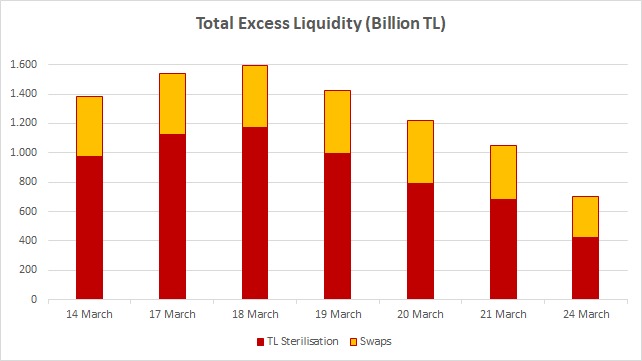
On liquidity management: First, conventional funding mechanism through one-week repos at the policy rate 42.50% have been suspended, and simultaneously the Monetary Policy Committee in an interim unscheduled meeting hiked the overnight O/N borrowing rate up to 46%. In the meantime, CBRT continued to cover real FX demand by the market, which means sterilising the liquidity through asset sales. In addition, excess liquidity was locked up using longer term TL deposit auctions, where the interest rate happens to be higher than the policy rate. On 21st and 24th March, an amount approximately equal to TL500 billion was withdrawn by that mechanism at 46% interest rate and with maturities p starting from O/N up to 4 to 8 weeks. Last, Central Bank introduced a new sterilisation tool and started to issue liquidity bills with maturities up to 91 days. Demand for 31 days liquidity bill on 24th March was TL84 billion, where bid-to-cover ratio remained at 22 percent. The effective yield of the bills was 47%. Excess TL liquidity has started to dry up, between 18 and 24 March, fall in market liquidity has been close to 1 trillion and counting.
On managing the FX demand: Although a large chunk of the FX demand originates from the speculative motive, part of it is associated with real sector’s risk aversion behaviour. Corporates rushing to purchase foreign currency for their future payments puts unnecessary pressure on the spot FX market, too. CBRT introduced Turkish lira-settled foreign exchange forward selling transactions in order prevent excess volatility in exchange rates due to this effect and stabilized foreign exchange liquidity. This is a very effective and efficient measure, especially combined with the ongoing FX sales of the Central Bank.
New framework for the functioning of the FX market: It is worth noting that the functioning of foreign exchange system has shifted in practice since 2019 and, without a comprehensive and wholistic view, one risks making a serious analysis error. Some analysts still use the parameters of the old FX system to interpret the current developments and hence their analyses fall short to explain what is going on. Similarly, their forecast describes a gloomier picture of the outlook and inevitably undershoot the market reality most of the times. Until 2019, the FX regime in Turkiye was extremely open and the functioning of the FX system had been conducted by the market actors at large. Starting from March 2019, this has changed dramatically. (By the way this shift was not peculiar to Turkiye, although one cannot deny the impact of domestic factors, but in line what we have been observing all over the world; a more protective, more interventionist, and more inward-oriented economic policy making.) In the current setting of the system, CBRT acts as a market maker; it clears the market as the ultimate buyer of foreign currency, and it holds the large part of the stockpile on its balance sheet. Thus, it is normal that CBRT is selling FX to cover the demand when it arises. In this new mechanism, the adequacy of the Central Bank international reserves should be measured compared to the available Turkish lira liquidity holdings of non-residents; simply because ultimately all FX deposits and holdings of residents become part of the nation’s international reserves, if the Central Bank wishes so. This should not cause a confusion or rather delusion that “Central Bank is burning other people’s money”. It is simply by an arithmetic identity and by construction, similar to conservation of energy, the very first law of thermodynamics. So even after having sold almost USD25 billion in a week, the Central Bank’s foreign exchange reserves above USD150 billion in gross and above USD50 billion in net terms plus USD9 billion of Treasury FX deposit seem strong enough to unwind any possible immediate movement.
In conclusion, owing to both effective liquidity measures and sound FX position, risk of having a dramatic and permanent deterioration in foreign exchange outlook, where TL depreciates to levels which may peril the inflation target and sustainability of the ongoing economic policies seem very low. This is due to the ability of the CBRT to take whatever necessary decisions without any delay and implement a monetary policy directly addressing the concrete and actual reflections caused by the deterioration of risk perception. This fact constitutes the main difference between the current situation and turmoil episodes in the past when Turkish economy was lacking this ability.
On Borsa Istanbul: Stock exchange reacted as theory would suggest; very badly for a few days. We observed significant drop in stock prices, in line with the prevailing risk-off mode. Especially on Friday, investors avoiding taking weekend risk oversold basically all shares. When the index touched critical levels serving as triggering thresholds for algorithms, further exacerbating the situation, and ultimately caused margin calls for leveraged positions. However, starting from Monday and partly because the “doomsday scenario” didn’t come true, calm was restored in Borsa Istanbul trading. Capital Market Board, the regulator of Turkiye introduced a series of measures to prevent excess market volatility. Short-selling was banned across all stocks, share buyback rules were relaxed in a bid and, the minimum equity capital protection requirement for margin trading was reduced to 20% from 35%. On 25th March, BIST100 index was close to USD260, 11.5% below its average over the last 12 months, but still above its deeps in January 2023 or November 2024.
Longer term economic outlook
While analysing potential impacts of the recent developments on Turkish economic outlook we need to consider more fundamental issues that may have an adverse effect on Turkish lira, inflation and economic activity.
On TL outlook: There are four factors that need to be considered: (i) current account deficit and its financing, (ii) risk of a substantial capital outflow, (iii) refinancing of maturing FX obligations of Turkish banks, non-financial corporates and, (iv) fiscal sustainability of the Government and the Treasury’s finances.
Current account deficit was USD10 billion in 2024 and even if it increases more than projected in the Medium Term Program (MTP) for 2025 say USD25 bln, it will still not be a risk factor to worry about, especially considering the GDP which is estimated to be close to USD1.5 trillion. Total amount of short-term portfolio investments held by foreign residents is around USD50 billion and even in a very unlikely event of a drastic outflow, this will not be a cause to devastation for the economic outlook. There are no reasons to expect a significant rollover risk neither for Turkish banks nor for the non-financial corporates. Although because of a rise in credit risk premium, the cost of borrowing may be higher, banks and corporates will be easily rolling over or refinancing their FX obligations on due date. Last but not the least fiscal outlook and especially public debt seem as the strongest feature of the Turkish economy and hence should not be an issue of concern. In conclusion fundamental factors do not suggest a high possibility for a significant depreciation of the TL, that may endanger the ongoing program.
On inflation and economic activity: Inflation will continue to fall in the coming months. By midst of the year, we expect year on year headline consumer price inflation to come below to 35% and for year-end our estimation is that the inflation will be between 28 and 25%. However, because of elevated risk premium, there is a high probability that the Central Bank may be less willing to continue its cutting cycle as previously estimated. We don’t expect the MPC to decrease policy rate in its April meeting. This means that risks on the economic activity are downward, and economic outlook has somehow gone south. High political tension will definitely hinder investment spending and may probably have an adverse effect on consumer confidence and hence consumption demand, too. Although this can be interpreted as good news for inflation outlook, economic activity may be adversely affected. Higher than previously envisaged TL interest rates, combined with softer than anticipated economic activity will have a negative impact on asset prices and especially stock exchange. So, the recovery in the Borsa Istanbul may be delayed until the second half of the year.
All in all, the risk that recent political development causes a financial crisis, a meltdown in markets and a permanent downturn in the economic activity is considered very low.