The Second ‘New World Order’
History shows that global ecological shocks have profoundly affected the planet,
humanity, and social structures. Volcanic eruptions, such as those in Iceland in 536 and
Tambora in Indonesia in 1815, caused “years without summer” in many parts of the
world, leading to widespread famine, migration, conflict, and even collapses of long-lived
empires. While such ecological disruptions were once the primary drivers of large-scale
economic and social change, today’s world operates differently. Earthquakes on
economic structures can now function as seismic shifts in the global political economy,
unleashing massive transformative changes.
Generations under 40 – the Millennials and Zoomers, also known as Generations Y and Z – are familiar with the global framework established in the 1990s under the banner of the
“New Global World Order”. However, the game is changing once again. A new world
order is taking shape, signaling a transformative era of systemic shift that cannot be
understood through the parameters of the past. Interpreting this emerging order, along
with its economic and financial dimensions, requires a multidisciplinary perspective that
draws on history, political science, and sociology.
A new era is upon us: the Second New World Order.
From the Cold War to the New World Order
We are in the early days of the second quarter of the 21st century. But I feel like I am in
the early years of the 20th century. If you think history always moves forward, you are
mistaken. Flashback – a return to the past – is not just a term used in cinema and
literature. This technique is used for purposes such as showing the past or
strengthening the narrative by jumping through time and space. If we think of stories
progressing in a straight line, a flashback deviates from this line and changes the flow.
Sometimes, history does the same.
History, undoubtedly, does not make itself; it is made by people, but definitely not as they
please. Social developments do not occur arbitrarily or randomly, they are rather shaped
by historical conditions. In social transformations, the real foundation or base
determined by economic structure and relations plays a decisive role. Nevertheless, the
reflection of this political economic substructure on the social stage takes shape through
sociopolitical dynamics. Ultimately, we need models to understand the dynamics that
produce social and political outcomes through complex processes and the choices
within this framework. Every model is a reduction and requires sacrificing some aspects
of reality to represent it into such a format that is suitable for analysis. This applies to the
model I will employ in this article as well, I assume that the driving force determining
social and political choices, as well as the mass psychology that guides them, is either
“hope” or “fear”.
Following the French Revolution and the Napoleonic Wars, which brought nearly a
century of conflict to Europe, the establishment of the German Empire ushered in a
forty-year period of peace and prosperity. This era, known as La Belle Époque (French
for ‘The Beautiful Era’), was followed by World War I, the Great Depression, and World
War II. After this age of chaos, the hope nurtured by the United Nations order,
established by the victors who defeated fascist aggression, but not for long. Starting in
the early 1960s, fear became the driving force shaping the world again and it drove
societies for the next 30 years.
During this period, two U.S. presidents were assassinated, and the world remained
plagued by economic crises and regional conflicts. However, the defining feature of
those three decades was undoubtedly the shadow of the thermonuclear apocalypse
threat caused by the Cold War. The most striking symbol of the bipolar world order as
one driven by fear was the precarious balance since both the U.S. and the Union of
Soviet Socialist Republics (USSR) possessed enough nuclear weapons to completely
destroy the planet – actually several times over – being described as the ‘stabilizing
factor’. This balance was referred to as the “balance of terror”’ Fear also reigned over
the developing world during this period, culminating in military coups and civil wars in
line with the zeitgeist or “spirit of the time”.
In the early 1980s, things were not going well on the Eastern front of the Cold War. The
military competition with the United States had drained the economy. The military force
of the USSR, the Red Army, had invaded Afghanistan but got stuck in the mire there.
After the death of Leonid Brezhnev, who led the USSR as General Secretary of the
Communist Party from 1964 to 1982, two successors died within two and a half years,
marking the end of the ‘Soviet gerontocracy’. This paved the way for the younger,
reformist Mikhail Gorbachev to take the helm. Gorbachev believed that the collapsing
Soviet economy required profound reforms within the Communist Party. During his
tenure, the world learned two Russian words: Perestroika (restructuring) and Glasnost
(openness). According to Gorbachev, the USSR needed perestroika, and the tool to
achieve it was glasnost.
Gorbachev’s optimism did not find traction on the ground. It was too late for a moderate
and gradual change from within, while keeping the state mechanism in place. The
loosening grip of the oppressive regime and the authoritarian Soviet iron fist sparked
demands for separation and independence among nations reluctantly included within
the Soviet Union and the Eastern Bloc. In November 1989, the wall dividing Berlin, a
symbol of the Iron Curtain(1), was torn down; followed by the dissolution of the eighty
year-old USSR. The Cold War ended, and the capitalist, freedom-oriented Western
Alliance emerged victorious.
During the last decade of the Cold War, Iraq, which had been fighting Iran on behalf of
Western interests in the Middle East for more than ten years, felt betrayed when Kuwait
rejected her demand for compensation. Believing it could act independently as a
principal rather than a proxy for the West, Iraq invaded Kuwait in August 1990, triggering
the First Gulf War. The name of the global order that shaped the world until recently was
coined during this war. In a joint session of the U.S. Congress on September 11, 1990,
President George H. W. Bush used the term “new world order” for the first time during a
speech about the conflict. The post-Cold War era was called the New World Order, and later, Globalisation.
What Happened to the First One?
The flagship of the victors’ front in the Cold War was the United States without doubts.
The U.S. emerged as the unrivaled leader of the Global World Order. One-third of global
production took place in the U.S., and 28% of global private consumption was driven by
American consumers. American hegemony was so magnificent that, as Francis
Fukuyama put it, “The End of History” had arrived. Humanity had reached its ideal form
of governance in liberal democracy and a capitalist economy. This framework would
define both individuals’ worldviews and the governance of states, and with no
alternatives remaining, change was deemed unnecessary.
Global integration brought an essential transformation to the economic structure and
relations. Freedom, the rule of law, democracy, and peace became fundamental political
values. Deregulation paved the way for marketization of economies all over the world.
Binding international norms were established through institutions like the International
Court of Justice, the World Trade Organization (WTO), the International Monetary Fund
(IMF), the World Bank, the Bank for International Settlements (BIS), and the
Organisation for Economic Co-operation and Development (OECD). Regional unions
deepened, and global coalitions began to assert the right to intervene in other sovereign
nation-states in the name of democracy, freedom, and human rights, when the
headquarters of the global order finds it appropriate.
Strategic concepts that helped explain the Cold War era – such as containment, the
Domino Theory, and the balance of terror – are replaced with a new vocabulary rooted
in globalisation, the Washington Consensus, and the End of History narrative.
The transformation was not limited to the language of international relations. Before the
1980s, the economic classification of nations was as industrialized countries, developing
countries, and underdeveloped countries. With global integration, industrial production
shifted from central countries to the periphery. The nations in the first group were now
labeled advanced economies. The developing countries of the past, shaped by the
development paradigm, earned the status of emerging market economies. Meanwhile,
the term ‘underdeveloped’ seemed inconsistent with the politically correctness required
by the new order, so these countries were referred to as frontier markets, indicating their
potential transition to emerging market status.
In economics, cross-border capital flows, global production networks, and value chains
became formative elements. Starting from the early 1990s, the dynamic that dominated
societies and shaped the world has been hope. The reign of fear waned, giving way to
an order founded on optimism.
The New or Global World Order, much like the Great Ideologies that preceded it,
promised to build a “paradise on Earth”. Global integration would advance, and since
the economic structure and relations (the base) were global, the superstructure would
inevitably follow suit. Nation-states were weakening, while supra-national entities were
gaining power. Rules determined by the cornerstone institutions of the global order were
adopted as superior norms and were overriding domestic laws of individual nation
states.
Eventually, humanity would reach the ultimate goal forged two centuries earlier by
Enlightenment philosopher Immanuel Kant in his essay Perpetual Peace: A Philosophical
Sketch: a global federation of free states, united as a single human family, living as world
citizens. The slogan of the French Revolution Liberté, Egalité, et Fraternité can serve
to construct an applicable framework for this analysis. Liberalism championed the idea
of liberty, while socialism raised the banner of equality. Globalisation encompassed
these first two principles and aimed to realize the ideal of fraternity, a big global family
of mankind leading us to the End of History.
Globalisation faced its first major challenge in 1997 Asian Crisis. The Asian Crisis was
the first crisis of this new global order. Unlike what orthodox crisis models suggest, the
emerging market economies known as the Asian Tigers did not fall into crisis because of
foreign trade deficits or unsustainable public finance, but financial imbalances caused by
capital inflows triggered it. For the first time, a crisis that did not originate from the
center of the world economy began to threaten the whole system. The crisis deepened
when it spilled over Russia, Brazil, Turkiye, and Argentina very quickly. Until that time,
the modus operandi of the world system was based on a club called the G-7, making
decisions on global issues. The seven advanced economies of the world (the United
States, Japan, Germany, France, the United Kingdom, Italy, and Canada) were coming
together and their unanimous decision was serving as directive to all international
organizations and institutions, from the IMF to the BIS, from NATO to the OSCE, and
from the OECD to the WTO. This crisis showed that the global order could no longer be
managed from the narrow old center. Referring to the framework of the post-Marxist
World System theory, there was a need for a broader arrangement involving countries
that could be referred to as semi-periphery. Thus, the center and the periphery would
integrate through the semi-periphery, and the system’s stability could be maintained. At
the end of 1999, a step was taken in Berlin to expand the G-7, leading to the
establishment of the G-20. In addition to the G-7 countries, China, India, Australia, South
Korea, Indonesia, Russia, Turkiye, Saudi Arabia, South Africa, Brazil, Mexico, and
Argentina were included. The European Union (EU) also was there as a separate entity.
In G-20 meetings, finance ministers and central bank governors represented the
countries, while the IMF-World Bank, OECD, and BIS, participated as observers.
Demise of the rich
In May 2004, an international conference on the issue of public debt in emerging market
economies was held, hosted by the Central Bank of the Republic of Turkiye (CBRT). The
conference had a distinguished attendance from top managers of international financial
institutions, economists, and senior bureaucrats from the participating countries,
including Anne Krueger, the Second Deputy Managing Director of the IMF, and
economist Kristin Forbes, who was a member of the White House Council of Economic
Advisors at the time. During the dinner, Michael Maresse, the Head of the Emerging
Market Economies Group for the EMEA (Central and Eastern Europe, Middle East, and
Africa) region and the Research Department at JP Morgan, posed the following question
to the guests at my table, where I, as a CBRT executive, was sitting: “When do you think
China will catch up with the United States and become the world’s largest economy?”
The topic was discussed in depth, and conclusion was China would catch up with the
U.S. by 2030. However, by 2013, China, including its then-integrated region Hong Kong,
had already surpassed the U.S. in terms of purchasing power parity-adjusted gross
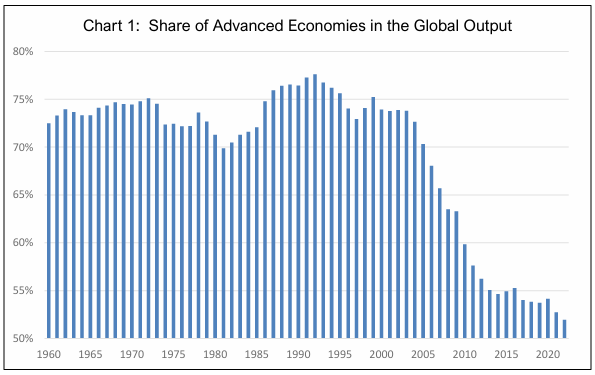
domestic product (GDP). The rich were unhappy with how quickly the poor were sharing
in the wealth. When the New World Order was established, the share of developed
economies, which represented 77% of the global economy, had decreased to 50%
following the global Covid-19 pandemic (Chart 1).
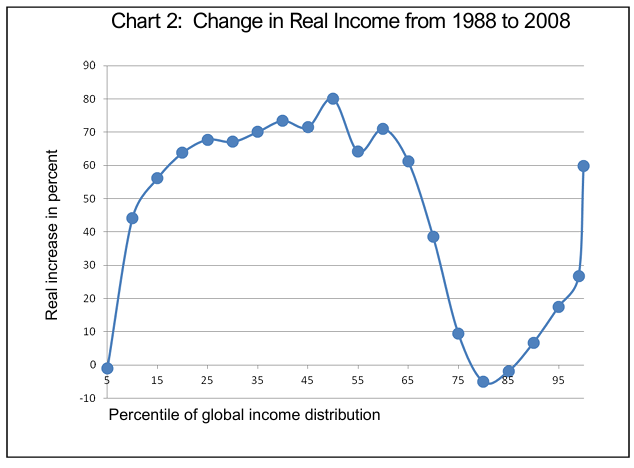
As developed economies lost ground to emerging market economies, ‘market’, the
magic word of the global order, also lost its charm. The second blow to the market
economy and liberalism came from the middle classes of developed economies. The
work of World Bank economist Branko Milanovic, Global Income Inequality by the
Numbers: In History and Now (2012), presents striking findings. The study exhibits the
change in real income of each of the groups classified as percentiles in the global
income distribution from zero up to the one hundred, measured in constant international
dollars between 1988 and 2008. According to his analysis, the poorest 5 percent of the
global population, who lacked both means and opportunities to integrate into the global
system, gained no benefits from globalisation. The bottom third of the global income
distribution experienced significant gains, with real incomes increasing between 40
percent and 70 percent. However, the largest increases were observed around 80
percent real increase at the median of the distribution and 70 percent at its
neighbourhood. It is there, between the 50th and 60th percentile of the global income
distribution that one finds hundreds of millions of inhabitants from the emerging markets;
200 million Chinese, 90 million Indians, and about 30 million people each from Turkiye,
Indonesia, and Brazil increased their real incomes significantly. The upper 5 percent of
the global value chain (or perhaps we should say the food chain) that enjoy a 60 percent
jump in their real income and the middle classes of emerging market economies were
indeed the main beneficiaries of globalisation. What threatened the system was that the
income of the middle class in developed economies had remained almost the same over
the past two decades (Chart 2). Barbarians once again were at the gates of the First
World.
The 2008 Global Crisis exacerbated this situation. The average individuals in the
advanced economies lost their status; for the first time since World War II, the current
generation in developed economies was poorer than their parents. Ten commandments
of the Washington Consensus brought the welfare social state model to end and
societies were anxious and angry. These countries, governed by democracy, a regime
which depends on the middle class, could no longer ignore the reactions of their middle
classes. The political center of gravity has rapidly shifted towards populism and
xenophobia. Political movements that strengthen by using extreme right-wing rhetoric
and protectionist promises has risen.
Discontents of globalisation
While the rich were unhappy, the poor were also dissatisfied with inequality and their
lack of sufficient representation in the global order. The deadlock at the G-20 Ministers
and Central Bank Governors’ meeting held in Gyeongju, South Korea, in October 2010
was caused by the demand from emerging market economies for more influence in the
global financial architecture and more voice in international financial institutions. The
meeting, where I represented the CBRT, lasted until 7:30 in the morning, but no
agreement was reached. The rich club was aware that the ‘barbarians’ had already taken
over the castle, but they were asking for a bit longer time for a smooth transition and
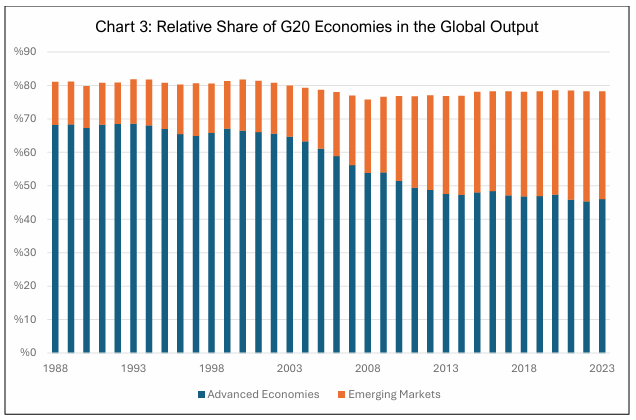
adjusting their positions. The speed of change was unacceptable to the Center. On the
other hand, representatives of emerging markets insisted that the fact “the world is
bigger than seven” should be acknowledged not only in words, but in deeds also. As the
share of developed countries in the global economy shrank from 70 percent to 46
percent, the share of emerging markets grew from 13 percent to 33 percent (Graph 3).
However, their influence in international fora’s decision-making processes had not
adjusted accordingly. The uprising at the 2010 Gyeongju meeting yielded some results
favouring EMs, but the improvement was very limited. Those carrying the burden of the
global order continued to be treated as second-class.
The unhappy were not only from developed and emerging economies. There was
another, far more critical unhappiness, the Earth! Our planet was unhappy with the
extensive destruction of its natural environment in the name of development and growth.
The model which made emerging market economies, especially China, the world’s
manufacturing hub achieved a spectacular success. Markets everywhere were awash
with vast amounts of products thanks to global supply chains, and costs were
unprecedently low. However, this achievement came only at the expense of a terrifying
environmental degradation, rainforest have been destroyed, plastic garbage patches
have been expanding in oceans, pollution, global warming, and climate change threaten
the delicate balance of Earth’s ecosystems. The years during which the world enjoyed
low inflation and high growth were made possible by converting the natural resources of
the planet into cash, and eventually we have arrived on the edge of the Anthropocene
mass extinction.
The third slogan of the French Revolution promised us a paradise on Earth, but the New
World Order turned it into hell. De facto global system lacking a global institutional
infrastructure was doomed to fail and in fact it did. It could have been achieved only if
global would have been established. The Global New World Order failed to provide all
parties a fair, just, inclusive, and environment-sensitive global governance model, and
thus global integration became a burden rather than an asset. Failure to cooperate
against a global crisis, Covid-19 pandemic, marked the end of global world order. The
curtain falls on the period of hope, which has lasted from 1990 to 2020, and the age of
fear inaugurated the reign of hope. Challenges and crises are ahead. Concepts that have
shaped our consciousness and perception are losing their significance. The causalities
and relationships we are familiar with do no longer have explanatory power. Fear brings
anger, anger brings irrationality, and irrationality brings hatred. We are entering a
darkness where the ghosts of the past, which we thought we had buried at the turn of
the millennium, are once again roaming.
Quo Vadis: The Fragmented World Order
The naming ceremony of the New World Order, conducted by a U.S. president in
Congress in September 1990 —let’s call this the First New World Order (1st NWO) to
avoid confusion, was followed 28 years later by another U.S. president who declared its
death at the United Nations General Assembly, one of the symbol institutions of the
World Order. In September 2018, U.S. President Donald Trump, who was scheduled to
speak at the UN General Assembly, was not present in the hall at the time of his speech
and missed his turn. In his delayed address, the message he delivered was like a nail in
the coffin of the 1st NWO: “As far as America is concerned, the ICC has no jurisdiction,
no legitimacy, and no authority…We will never surrender America’s sovereignty to an
unelected, unaccountable, global bureaucracy… America is governed by Americans…
We reject the ideology of globalism, and we embrace the doctrine of patriotism. Around
the world, responsible nations must defend against threats to sovereignty not just from
global governance, but also from other, new forms of coercion and domination.”
Especially with Donald Trump’s victory in the presidential elections held in November
last year, there has been a widespread belief that a new era is beginning. Since Trump
was elected, protectionist policies would be implemented, countries would close
themselves off, global norms and liberal values would be disregarded, environmental
consciousness and green transformation would be shelved, and in short, a system of
division, hostility, and conservatism would reign. Mr. Trump was seen not only as the
representative (symbolic figure) of this change but also as the cause (the factor leading
to its emergence). Leaders and their decisions play a role in the course of events, they
can affect the speed of change, but they cannot determine the social and political
phenomena on their own. As previously mentioned, historical conditions bring major
changes. The more one tries to explain the situation by attributing too much credit to
individuals, the greater the risk of underestimating the influence of the sub-structure.
This is exactly why explaining the change in the world order by the rise of far right and
populist leaders would be misleading. In fact, the causality works just in the opposite
direction. In other words, Mr. Trump’s victory in presidential elections is not the cause for
a tragic change in the world order, but rather the fundamental change that has been
happening brings political leaders like Mr. Trump to power in many jurisdictions.
However, it is clear that the political inclination of the United States will have a significant
impact on the changing world order. The main axis to define both global geopolitics and
economic politics in the coming period seems to be the hostile competition between the
U.S. and China, which will inevitably evolve into a confrontation. The tension between
the U.S. and China has already started to build up and, since the root cause is structural,
regardless of the result of presidential elections the conflict is destined to arise. Under
the Trump administration, it seems combat will be more direct, more extensive, and
more intense. The problem is that, just like unrest is contagious in a herd, protectionism,
isolationism, and irrationality are also contagious among nations. The tension between
the world’s two largest economies and most formidable military powers will load an
immense geopolitical energy to the system that triggers earthquakes along fault lines,
shaking the entire world.
John Nash’s game theory model, particularly his concept of the Nash equilibrium, is
essential for understanding the functioning of this Second New World Order. The Nash
equilibrium, named after him, describes a scenario where all parties involved, despite
the outcome being the least favourable for all, are compelled to make decisions that lead
to that very outcome. This is best explained using the “Prisoner’s Dilemma” model.
In this model, two criminals who have committed a crime together are arrested and
interrogated in separate cells, with no possibility of communicating with one another.
The police lack enough evidence to convict them without a confession, and both
criminals are aware of this. As the prosecution pressures them for a confession, the
criminals consider the following options:
a) If neither confesses, they will both serve a one-year prison sentence, and hence the
outcome matrix for that strategy is (-1; -1).
b) If one confesses but the other denies, the confessor is released, whilst the other faces
ten years in prison for misleading justice (0; -10 or -10; 0).
c) If both confess, the evidence against them will be solid, and their confessions won’t
help them. They will each receive a six-year prison sentence (-6; -6).
The dilemma arises because both prisoners face the temptation to betray the other for a
better individual outcome, yet if both betray, they both end up worse off than if they had
cooperated and remained silent. This paradox defines the Nash equilibrium, where
neither party has an incentive to unilaterally change their strategy, although they are
aware they are going to end up with the worst outcome.
As a result, the dominant strategy for both players is to betray the other, leading to a
worse outcome for both (-6; -6), rather than the optimal solution (-1; -1). This outcome
represents the worst possible one in the game, but escaping it is impossible. Similarly,
when countries are engaged in free trade with one another, this would lead to the best
overall outcome. However, if one country turns to protectionism to benefit itself at the
expense of others, it could trigger the collapse of the entire system.
The dynamics that will shape the next decade of the Second New World Order include
the loosening of integrations created by globalisation, the disintegration of global value
chains, a shift towards protectionism under the banners of “localism and nationalism,”
and countries resorting to coercive measures to ensure production and investment
occur within their own borders. This will result in hostile competition and a more
adversarial global environment, which will mirror the Nash equilibrium of the prisoner’s
dilemma model. As a consequence, a world with worse economic conditions and more
intense competition will emerge.
Global integration will weaken and be replaced by a fragmented one, more localized
where regional economic networks become more important. The model that allowed for
the economic miracle of the last thirty years —characterized by high growth with falling
inflation— was based on the production of parts at the cheapest locations, the free
circulation of goods & services and factors of production through global supply chains,
and the sharing of added value across global value chains. This model seems to leave its
place to a new one based on more limited and temporary collaboration. However, as
Heraclitus said, “no man ever steps in the same river twice. For it’s not the same river
and he’s not the same man.” meaning we won’t move towards a completely dystopian
world like the one portrayed in Mad Max. Instead, we will experience a fragmented
version of globalisation.
As a result, the economic system of the Second New World Order is estimated to bring
a more volatile financial system, with higher inflation, and hence higher capital costs.
Trade volumes is expected to remain subdued. However, it is not all gloom and doom. In
the past, we had several similar episodes, and it turns out they were all caused by
reaching boundaries of then existing’s production model. Each and every time when it
got the darkest, we had a technological jump, combined with the economic
implementation of it, which paved the way to innovation, productivity increase, higher
efficiency and finally a superior production possibility boundary and thus a more
auspicious efficient market frontier at macro level. The revolutionary breakthroughs that
may occur in artificial intelligence, materials science, molecular biology, genetics, and
energy could, in reference to Kuhn’s terminology, “liberate us from the yoke of the
ordinary economy.”
This is best defined in Charles Dickens A Tale of Two Cities, “It was the best of times, it
was the worst of times, it was the age of wisdom, it was the age of foolishness, it was the
epoch of belief, it was the epoch of incredulity, it was the season of Light, it was the
season of Darkness, it was the spring of hope, it was the winter of despair, we had
everything before us, we had nothing before us…in short, the period was so far like the
present period, that some of its noisiest authorities insisted on its being received, for
good or for evil, in the superlative degree of comparison only”.
The Economic Impact of the New Order
Since the Second New World Order will be with us for some time, we will have the
opportunity to get to know it better. Therefore, we can move away from theoretical
analysis and focus on a more concrete evaluation of the effects this change will have on
the world economy and the Turkish economy by 2025, when the change will be fully
experienced. We know that pressures on the Chinese economy will increase. It would
not be surprising if companies with Chinese investors or those with strong relationships
with Chinese suppliers also come under pressure. As a natural consequence of the
U.S.’s siege and containment policy towards China, the global economy will also be
affected. However, the model that created China’s economic success worked as follows:
massive amounts of mass production and, thanks to both the economies of scale and
negative externalities, low costs, the export of domestic output surpluses, and the
provision of financing opportunities to those who want to buy Chinese goods, supported
by the excess savings created by suppressing domestic consumption. What turned the
success story into a miracle was that the capitalist economic model was run under state
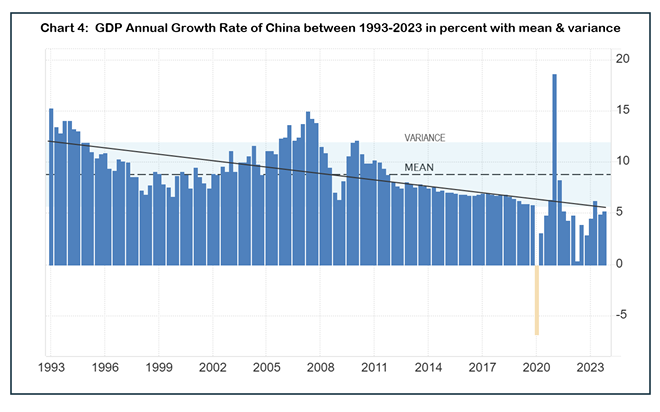
ownership, allowing this cycle to continue indefinitely. Since 2019, every obstruction
introduced to the system has led to major disruptions. The Chinese economic system,
which had achieved an average annual growth rate of nearly 9% for a quarter-century
during the First New World Order period, encountered growth below 5% for the first time
at the end of 2019. Today, even that has become an unreachable dream (Graph 4). The
inflation data, which further worsens this scenario, signals that China may be heading
towards the “Japanification” deadlock.
Due to the likely production loss in China, the Chinese industry will not generate the high
demand for commodities that it once did, leading to a weak outlook for commodity
prices. In addition, it seems that the Trump administration will pursue a policy of
reducing energy costs in order to balance the discomfort that U.S. consumers will feel
from cost increases due to import tariffs. Low oil prices will also help keep producers like
Russia and Venezuela under control. In this regard, risks related to oil prices will be
downward. It is expected that the Trump administration will take steps such as
supporting reserve producers like Nigeria and Libya, pressuring Saudi Arabia to loosen
production restrictions, bringing unused U.S. resources into play, including Alaska oil,
due to environmental concerns, and finally easing restrictions on coal, all of which point
to a weaker outlook.
A decrease in the United States’ interest in European affairs and, more importantly, its
support is inevitable. The slogan “Keeping the U.S. out of the world’s troubles,” which
echoes a return to isolationism that formed the foundation of the Republican Party’s
foreign policy preferences until Roosevelt, received support from voters during the
election campaign. Additionally, Trump is attempting to cut all costs that could help
reduce taxes domestically. Spending money on European security is one of the last
things he would want to do. This means the EU will be left to face Russia alone. On the
other hand, isolationism does not prevent the U.S. from exerting pressure on the EU to
reduce its economic ties with China. Over the past year, the U.S. imported nearly $780
billion worth of goods and services from the EU, while its exports to the EU were below
$650 billion. The likelihood that the Trump administration will impose higher tariffs on the
EU and even introduce non-tariff barriers is not negligible. It is known that the U.S. wants
to weaken the Russia-China axis in its confrontation with China. If Russia steps back
from cooperation with China, it would not be surprising if some concessions are made to
Putin. This would be another move that would not be well-received by the EU.
The spread of protectionist policies and populism will negatively affect the global
economy, international trade, and emerging market economies. Additionally, there is a
trend where the U.S. dollar will likely strengthen in global markets due to both economic
and geopolitical factors. These developments will also negatively affect capital flows to
emerging market economies.
Turkiye: Can opportunities overweigh threats?
Geopolitical tensions, like tectonic ones, break the system at its most vulnerable spots.
Turkiye, is in a position exposed to risks due to both geological and geopolitical fault
lines. So, nothing happening in Turkiye is solely about Turkiye.
Turkiye has been a country that closely monitors developments in the global system and
tries to respond accordingly. Therefore, it is useful to understand recent changes from
this perspective. Economic policies were liberal, in harmony with the world in the 1920s.
In the 1930s, Turkiye, along with the world, became more authoritarian. In the 1950s,
Turkiye supported the Atlantic Alliance, in the 1970s it embraced developmentalism, and
in the 1980s, it became a supporter of marketization and liberalization. Similarly, the
Tanzimat reforms coincided the Congress of Vienna, the Islahat reforms followed the
Paris Agreement, and the establishment of the United Nations inspired the shift to multi
party political system.
So why should it be any different now?
The developments to the north of the Black Sea and in Europe, the conflict environment
to the south of Turkiye, the aftershocks caused by U.S.-China tensions, and the
reflections of the new order in the global economy constitute significant challenges to
Turkiye. The good news is that Turkiye has considerable experience in dealing with
difficulties, this has never been an easy geography. Basically the size of the domestic
market, high private consumption, strong entrepreneurial culture and flexibility of
corporates have always provided kind of immunity against external shock. There are
some favourable factors too; main import item for Turkiye is commodities and thanks to
softening economic activity commodity prices expected to remain subdued.
U.S. aims to restrain the expansion of China and is definitely going to increase its
containment of China, and China subsequently will take countermeasures. Excess
production capacity of Chinese economy is a clear and present threat for almost all
advanced Western economies. Over the last two decades, Chinese enterprises have
created fierce competition and several production plants in Europe have had to cease
their operation. Partly because of this, those same economies have developed
dependencies over time on supply of merchandise from China, the sole producer with
the ability to secure the sizeable amount of supply they need. Should severe restrictive
measures on China’s exports be taken without a substitute, this may have devastating
impacts over especially EU industries Mr. Trump has already made clear that U.S. will
impose high tariffs on China, and if a vendor uses China originated feedstock in
production, it will be probably subject to the same rate of taxation. This aggravates the
problem for EU. As a member of EU custom union, and with over USD300 billion of
highly qualified and diversified industrial production, Turkiye is already competing with
China in various segments, and seems to be the most viable candidate in the CEEMEA
region for customers seeking alternative to Chinese suppliers.
During Mr. Trump’s first presidency he withdrew the U.S. from the Transatlantic Trade
and Investment Partnership (TTIP) with the EU. Trump’s team has already warned
European officials that the incoming U.S. president will demand NATO member states
increase defence spending to 5 per cent of GDP, too. Thus, the relationship between the
U.S. and the EU is expected to be impaired by isolationism and protectionism. The
weakening of the alliance between the U.S. and Europe on the other hand, will increase
Turkiye’s relative foreign policy weight for both actors. A possible loosening of the
sanctions on Russia will also provide Turkiye with more flexibility. Geopolitical
developments in the Middle East, and especially in Syria also indicate that Turkiye’s
scope and influence will increase. Hosting millions of immigrants for more than a decade
was a serious cost, but now it is paying back. Once stability will be restored and an
agreement will be reached, hydrocarbon resources from the Eastern Mediterranean
region can easily flow to Europe through already operating pipelines. However, moving
opportunities from potential to kinetic requires capacity, competence, and skill. A critical
question is how much risks Turkiye will face will allow her to take advantage of the
opportunities that will arise in 2025. Weak global demand, reduced risk appetite,
increased financing costs, and difficulties in accessing finance are challenges Turkiye
must overcome. Though improvement in Turkiye’s economic performance since June
2023 is promising, there are still a lot to do. Good news is that the base effect is helping;
while several other emerging markets are coping with a deteriorating outlook, Turkiye is
relatively bettering off, because she has already left the worst behind. So, if Turkiye plays
her cards rights, opportunities may overweigh challenges, at least in the short term. And
in the long run we are all deads…
(1) In a speech delivered in 1946, British Prime Minister Churchill stated “From Stettin in the Baltic to
Trieste in the Adriatic, an iron curtain has descended across the continent” – a phrase he used to describe
the Eastern Bloc.
Charts